

Cookies Policy

The website of the University of Cádiz uses its own and third-party cookies to carry out analysis of use and measurement of traffic, as well as to allow the correct functioning in social networks, and in this way to improve your browsing experience.

If you want to configure cookies, press the button Customize Cookies. You can also access the cookie settings at any time from the corresponding link in the footer.

For more information about cookies you can consult the Cookies policy from the website of the University of Cádiz.

Cookies customization

The website of the University of Cádiz uses its own and third-party cookies to carry out analysis of use and measurement of traffic, as well as to allow the correct functioning in social networks, and in this way to improve your browsing experience.

For more information about cookies you can consult the Cookies policy from the website of the University of Cádiz. You can also access the cookie settings at any time from the corresponding link in the footer.

You can configure the website cookies according to their purpose:

  • Statistical analysis

    Third-party cookies (Google Analytics) are used on this site that allow the number of users to be quantified anonymously (personal data will never be obtained to identify the user) and thus be able to analyze the use made by users of our service, in order to improve the browsing experience and offer our content optimally.

  • Social networks

    Third-party cookies are used on this website that allow the proper functioning of some social networks (mainly YouTube and Twitter) without using any personal data of the user.

UniversidaddeCádiz
Facultad Ciencias del Trabajo
evento

II Torneo de Debate ARELCIT 27 February 2026
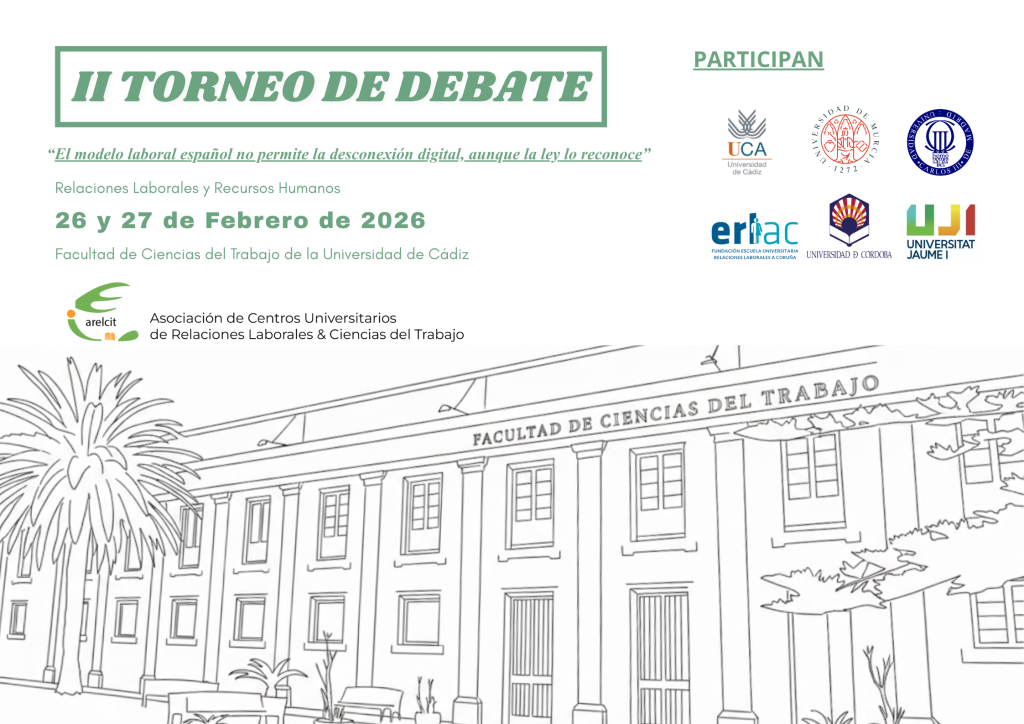
II Torneo de Debate ARELCIT

La Facultad de Ciencias del Trabajo de la Universidad de Cádiz acogerá los próximos 26 y 27 de febrero de 2026 la nueva edición del II Torneo de Debate ARELCIT, un encuentro académico que reunirá a varios equipos universitarios de alumnado del Grado en Relaciones Laborales y Recursos Humanos procedentes de distintos puntos del país.

Se trata de una iniciativa orientada a fortalecer en el alumnado competencias esenciales como el análisis crítico, la argumentación sólida, el pensamiento estructurado y la oratoria. Estas habilidades resultan especialmente relevantes en el actual contexto sociolaboral, donde la capacidad de comunicación, el razonamiento fundamentado y la reflexión estratégica marcan la diferencia en el entorno profesional.

En esta convocatoria, los equipos participantes abordarán un tema de plena actualidad y notable impacto en las relaciones laborales: “El modelo laboral español no permite la desconexión digital, aunque la ley lo reconoce”. Cada equipo deberá defender su postura a favor o en contra, determinada por sorteo previo al comienzo de cada enfrentamiento.